
![How Much Does It Cost to Start an LLC in [year]?](https://www.doola.com/wp-content/uploads/2025/11/banner-cta-new.png "How Much Does It Cost to Start an LLC in [year]?")
Form Your LLC Today. Foreign Founders Welcome.


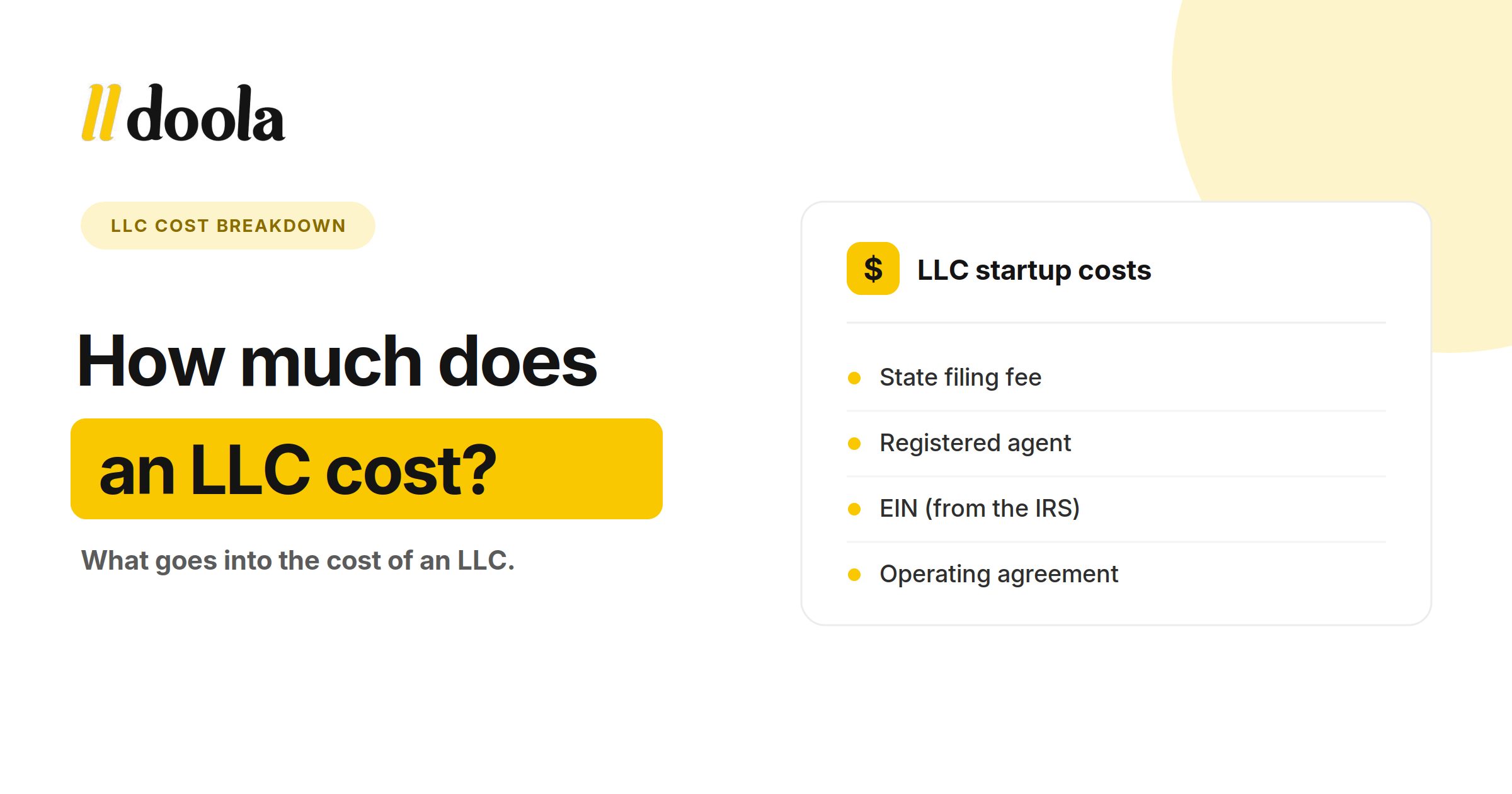
The Short Answer: How Much Does It Cost To Start an LLC in 2026?
Most single-member LLCs, freelancers, and first-time founders spend between $200 and $1,500 in their first year. That total includes costs like a registered agent, an LLC formation service, first-year compliance, and state filing fees, which vary by state ($35 to $500).
The one-line decision rule for the best US state to start an LLC:
- You live outside the US and run an online business: New Mexico or Wyoming
- You are raising institutional capital: Delaware
- You live and operate in a specific US state: Form in that state
A Business.org survey of 700 small business owners found that more than half underestimated what they spent in their first year of business.
For many business owners, that mistake starts with focusing only on the LLC filing fee. It is the number people search for first, but it is not the full cost of forming and maintaining an LLC.
Depending on the state, you may also need to pay annual report fees, franchise taxes, registered agent fees, publication costs, or foreign LLC registration fees if you operate in a different state from the one where you formed your company.
Here is the full picture:
| Cost Item | Typical Range | Frequency |
|---|---|---|
| State filing fee | $35–$500 | One-time |
| Registered agent fee | $0–$299 | Annual |
| LLC formation service fee | $0–$299 | One-time |
| Annual report / franchise tax | $0–$800+ | Annual |
| EIN | Free | One-time |
| Estimated total, first year | $200–$1,500+ | N/A |
Figures sourced from 2026 state Secretary of State fee schedules and doola’s published pricing. The average LLC filing fee across all 50 states in 2026 is $132.
Before you file: Three costs this table does not show:
- California’s $800 minimum franchise tax is waived in your first taxable year under AB 85. Starting in Year 2, it applies regardless of revenue; even at $0.
- New York’s publication requirement adds $1,000 to $2,000 in Year 1 alone.
- And many registered agent services double their price from Year 1 to Year 2 when promotional rates expire.
The sections below cover all of it.
Not sure where to start? See exactly what is included in doola Starter
Total Cost Comparison: DIY vs. doola in 2026
DIY LLC vs formation service is not a comparison of free vs. paid. It is a comparison of two different ways to spend money, with different risk profiles and time costs attached.
| Cost Item | DIY Year 1 | doola Starter ($297/yr) | doola Tax+Compliance ($1,999/yr) |
|---|---|---|---|
| State filing fee | $35–$500 | Included | Included |
| Registered agent | $100–$299 | Included | Included |
| Operating agreement | $0–$150 | Included | Included |
| EIN | Free | Included | Included |
| BOI filing | Free* | Not included | Included |
| Annual report (Year 1) | $0–$800+ | Included | Included |
| Bookkeeping setup | $0–$500+ | Not included | Included |
| Professional / CPA fees | $500–$3,000+ | Not included | Included |
| Total Year 1 estimate | $885–$5,000+ | $297 + state fee | $1,999 + state fee |
US-formed domestic LLCs are currently exempt from BOI reporting as of March 2025. Foreign-owned entities may still have obligations. Full update in the compliance section below.
3 Things Worth Understanding Before You Decide
1. Why the DIY Range is Wide
CPA and professional service fees vary drastically. While the baseline state filing costs are low, adding professional management can easily transform a ~$385 first-year DIY stack into a $2,000+ operation.
2. doola Starter ($297)
Starter bundles everything a first-year LLC needs into one number. No upsells, no renewal surprises. It includes:
- State business filing
- Registered agent service
- Operating agreement template
- EIN (Employer Identification Number) acquisition
- Automated compliance reminders
3. doola Tax and Compliance ($1,999/year)
Tax+Compliance includes bookkeeping software and handles federal and state tax filing.
The alternative requires hiring an independent CPA at $400–$800 per tax filing, plus purchasing separate standalone bookkeeping software.
Cost Comparison: DIY vs. doola Starter
When you factor in hidden overhead, doola Starter is priced competitively against a traditional DIY stack, even before calculating the value of your own time.
| Component / Expense | Traditional DIY Route | doola Starter Plan |
|---|---|---|
| Registered Agent | $100–$299 / year | Included |
| Operating Agreement | $50–$150 (Template) | Included |
| EIN & BOI Filing | $0 (But requires manual faxing/mailing) | BOI filing not included |
| Your Time Invested | 8–20 hours navigating complex state portals | 0 hours (Fully managed) |
| Baseline Cost (Excl. State Fees) | $150–$449 + Heavy Time Investment | $297 / year |
The Bottom Line: If you have more time than capital, a meticulous DIY approach saves cash upfront.
However, if you want to avoid administrative friction, missing state deadlines, or spending hours handling IRS paperwork, doola Starter delivers immediate value from day one.
Before choosing between DIY and a formation service, you need the actual state fee numbers, because the right choice partly depends on where you are filing.
LLC Filing Fees by State in 2026
The filing fee is a one-time cost. The annual report fee LLC or franchise tax is what you pay every year your LLC is active, and in several states that recurring number matters far more than the upfront one.
The table below breaks down LLC filing fees by state, including formation costs, and annual fees to watch before you choose where to register your business.
| State | Filing Fee | Annual Report / Franchise Tax | Notes |
|---|---|---|---|
| Montana | $35 | $20/yr | Lowest filing fee in the US |
| Kentucky | $40 | $15/yr | Second-lowest filing fee |
| Arkansas | $45 | $150/yr | Low entry; higher annual |
| New Mexico | $50 | $0 | No annual report; popular with non-residents |
| Arizona | $50 | $0 | No annual report for LLCs |
| Colorado | $50 | $10/yr | Low-cost, low-maintenance option |
| Ohio | $99 | $0 | No annual report |
| Wyoming | $100 | $60/yr | No state income tax; strong privacy |
| Georgia | $100 | $50/yr | Straightforward; low recurring cost |
| Florida | $125 | $138.75/yr | No state income tax |
| North Carolina | $125 | $200/yr | Mid-range on both ends |
| Illinois | $150 | $75/yr | Higher filing fee; moderate annual |
| New York | $200 | $9 biennial + $500–$2,000 publication | Publication requirement dominates Year 1 |
| Texas | $300 | Requires a Public Interest Report; franchise tax varies by revenue | No state income tax |
| Delaware | $90 | $300 franchise tax/yr | Right for VC-backed; expensive for everyone else |
| Nevada | $425(Nevada’s $75 Articles of Organization fee is required in addition to the mandatory State Business License ($200) and Initial List of Members ($150) at formation) | $350/yr | Strong privacy; high annual cost |
| Massachusetts | $500 | $500/yr | Most expensive state to form and maintain |
| California | $70 | $800 minimum/yr | Franchise tax applies even at $0 revenue |
The best state to form an LLC depends on your situation:
For non-US residents with online businesses: Wyoming and New Mexico usually offer the lowest annual costs if you have no physical presence in the US.
For startups raising venture capital: Delaware is usually the better choice because investors, lawyers, and institutions are used to working with Delaware companies.
For US-based small business owners: Florida is a balanced option. It has a $125 LLC filing fee, no state income tax, and a $138.75 annual report fee.
For cost-sensitive founders: Be careful with California and Massachusetts. Both can cost $1,000 or more per year in ongoing state fees before you even count other business expenses.
One important warning: forming your LLC in a cheaper state does not always save money.
If you live in another state or physically operate your business there, your home state may still require you to register your LLC as a foreign LLC. That means you may have to pay:
- Your original formation state fees
- A foreign LLC registration fee in your home state
- A registered agent fee in both states
- Ongoing annual fees in both states
So, forming in a low-cost state like Montana, Wyoming, or New Mexico can backfire if your actual business activity triggers registration in a high-cost state like California.
More on this is covered in sections below.
One-Time Costs vs. Recurring Annual Costs: Know the Difference
This is the distinction that catches most first-time business owners off guard. They budget for formation and are genuinely surprised when Year 2 invoices arrive.
The LLC annual report fee and registered agent annual fee do not go away. They come back every year your LLC is active.
| One-Time Costs | Recurring Annual Costs |
|---|---|
| State filing fee | Registered agent fee |
| Operating agreement | Annual report fee |
| EIN (free from IRS) | State franchise tax LLC |
| BOI / FinCEN filing | Bookkeeping (if ongoing) |
| Formation service fee | Tax preparation |
What 3 Years Actually Look Like
| Scenario | Year 1 | Year 2 | Year 3 | 3-Year Total |
|---|---|---|---|---|
| DIY, low-cost state, no professional help | ~$385 | ~$160 | ~$160 | ~$705 |
| DIY with CPA and bookkeeper | ~$2,000+ | ~$800+ | ~$800+ | ~$3,600+ |
| doola Starter | $297 (state fee paid separately) | $297 (state fee paid separately) | $297 (state fee paid separately) | $891 (state fee paid separately) |
| doola Tax+Compliance | $1,999 (state fee paid separately) | $1,999 (state fee paid separately) | $1,999 (state fee paid separately) | $5,997 (state fee paid separately) |
Most people budget for formation. The bill that surprises them arrives in Year 2.
The Hidden Costs of Forming an LLC (What Most Guides Skip)
Formation services and state websites do not put these on their pricing pages.
Here they are anyway, with real dollar figures so you know what you are walking into before you commit to a state or a service.
1. BOI / FinCEN Filing: 2026 Status
As of March 2025, FinCEN exempted all US-formed domestic LLCs from BOI reporting. If your LLC was formed under US state law, you are not currently required to file.
Foreign-owned entities formed under foreign law and registered in a US state may still have filing obligations. The rule is described as interim.
Monitor FinCEN.gov for updates if your LLC has foreign beneficial owners.
2. Registered Agent Renewal Pricing
Many services offer $0 to $49 in Year 1 as a promotional rate, then auto-renew at $150 to $299.
Read the renewal terms before you sign up. The Year 1 price and Year 2 price are often very different numbers.
See a full registered agent cost breakdown by state.
3. California’s $800 Minimum Franchise Tax
California’s $800 minimum franchise tax is waived in your first taxable year under AB 85.
Starting in Year 2, it applies regardless of revenue; even at $0. There is no exemption for new businesses or slow periods.
If you are forming in California, build $800 into your budget before you file.
4. New York’s Publication Requirement
Every new New York LLC must publish a formation notice in two state-designated newspapers for six consecutive weeks within 120 days of forming.
In New York City, this costs $1,000 to $2,000 or more. In upstate counties, typically $200 to $500. Skipping it results in LLC suspension.
5. Bookkeeping and Tax Preparation Catch-Up
If you do not track finances from Day 1, reconstructing records at tax time costs $500 to $2,000 or more.
It is avoidable but remains one of the most common first-year surprises. Tax+Compliance includes bookkeeping software and handles federal and state tax filing.
6. Re-Filing Fees After Rejection
States reject Articles of Organization for name conflicts, missing information, and formatting errors.
When that happens, you pay the full state filing fee again and lose weeks of formation time.
6 Compliance Penalties That Cost More Than Your Entire Formation Fee
Most LLC cost guides cover formation. They skip what it costs when you miss a compliance obligation after forming.
These are the real numbers. Most of these obligations apply only to foreign-owned LLCs. If your LLC is US-owned, the registered agent and annual report rows are the ones to watch.
| Obligation | Annual Cost | Penalty if Missed | Who It Applies To |
|---|---|---|---|
| Form 5472 + pro forma 1120(a US corporate tax form required alongside Form 5472) | $300–$500/yr (via service) | $25,000 per form, per year | Every foreign-owned LLC |
| Registered agent | $100–$299/yr | Entity dissolution | Every LLC in every state |
| State annual report | $0–$800/yr | $200+ reinstatement fee; potential dissolution | Most states |
| FBAR (FinCEN 114) | $0 (self-file) | Up to $16,536 per annual report (per filing) (non-willful); $165,353 or 50% of balance (willful) | If foreign accounts exceed $10,000 |
| BOI report (FinCEN) | $0 (self-file) | Currently suspended for US-formed LLCs; foreign reporting companies still at risk | Foreign reporting companies |
| Bookkeeping | $0–$200/month | No fine, but required to file Form 5472 accurately | Recommended for all |
💡 Did You Know?
Non-US residents who own a US LLC must file Form 5472 every single year, even at zero revenue.
Miss it and the IRS charges $25,000 per form, per year. No minimum revenue threshold. No exemption for inactive LLCs.
Note on FBAR: FBAR applies to US persons (citizens, green card holders, resident aliens) who have foreign financial accounts totaling more than $10,000 at any point during the year. It is separate from your tax return and filed directly with FinCEN. Non-willful penalties are up to $16,536 per annual report (per filing) per year. Willful violations can reach the greater of $165,353 or 50% of the account balance.
Need help staying compliant? See what our Tax and Compliance package covers
Cost to Start an LLC as a Non-US Resident in 2026
Most formation guides skip LLC costs for non-US residents entirely. Non-US residents can absolutely form a US LLC. The process costs more and takes longer. Here is exactly what to expect.
In fact, the overall process is largely identical to that of a US resident. However, international entrepreneurs must navigate 3 meaningful differences in cost and process that can significantly impact their initial budget and timeline:
1. A Registered Agent Is Required: No Exceptions
Non-residents cannot use their own address as a registered agent because they do not have a qualifying US address in their formation state. A professional registered agent fee cost of $100 to $299 per year is mandatory.
2. Getting an EIN Takes Longer
US residents get an EIN instantly online through IRS.gov at no cost. Non-residents without a US Social Security Number must apply via IRS Form SS-4 by mail or fax: four to eight weeks. Using a service costs $0 to $150 and removes the complexity of navigating IRS fax procedures from abroad.
3. BOI Filing: What Non-Residents Need to Know
Domestic LLCs formed under US state law are currently exempt from BOI filing, even with foreign beneficial owners. If your entity was formed under foreign law and registered in a US state, you may still have filing obligations.
Filing is free; it requires a valid passport number and country of issuance for each beneficial owner listed.
One distinction worth knowing: an EIN is your business tax ID. An ITIN is a personal tax ID for individuals without a Social Security Number. Some non-resident business owners need both, depending on how they plan to file US taxes personally.
| Cost Item | US Resident | Non-US Resident |
|---|---|---|
| State filing fee | $35–$500 | $35–$500 (same) |
| Registered agent | $100–$299/yr | $100–$299/yr (required) |
| EIN | Free, instant online | $0–$150, 4–8 weeks via Form SS-4 |
| BOI / FinCEN filing | Currently exempt | Varies by entity type |
| Form 5472 + pro forma 1120 | Not required | $300–$500/yr via service (required) |
| Formation service | $0–$299 | $0–$299 |
| US bank account | Standard process | Slash or Relay recommended |
Opening a US business bank account is one of the most common pain points for non-residents. Plus, traditional US banks are significantly harder to access without a physical US presence or SSN.
Non-US business owners carry additional compliance obligations that most formation guides do not mention. Form 5472, FBAR (if applicable), and state annual filings each carry significant penalties if missed.
doola handles all of it, including EIN acquisition via Form SS-4, in a single package built specifically for international business owners.
DIY vs. Formation Service: Honest Trade-Offs in 2026
The state filing fee is not the cost to form LLC online yourself. The real DIY cost is in research time, error risk, compliance deadline tracking, and downstream CPA fees when something goes wrong.
Full DIY Cost Breakdown
- State filing fee: $35 to $500
- Registered agent: $100 to $299 per year
- Operating agreement template: $0 to $150
- EIN: Free
- BOI / FinCEN filing: Free (domestic LLCs currently exempt)
- Annual report (Year 1): $0 to $800+
- Professional fees (if errors occur): $200 to $1,000+
- Time cost: 8 to 20 hours in Year 1
| Factor | DIY | doola Starter | doola Tax + Compliance |
|---|---|---|---|
| State filing | You handle directly | Paid separately | Paid separately |
| Registered agent | You source separately | Included | Included |
| Operating agreement | Template or attorney | Included | Included |
| Compliance reminders | Self-managed | Yes | Yes |
| Tax preparation | You hire separately | Not included | Included |
| Bookkeeping | You manage | Not included | Included |
| Estimated Year 1 cost | $885–$5,000+ | $297 + state fee | $1,999 + state fee |
| Time required | 8–20 hours | ~1 hour | ~1 hour |
| Error risk | Higher for first-timers | Low | Low |
- When DIY makes sense: If you have already formed an LLC before and know your state’s portal, the DIY route in Montana or New Mexico is hard to beat.
- When an LLC formation service pays for itself: First-time filers, non-residents, anyone forming in New York or California, and anyone who cannot afford to lose weeks to a rejected filing. doola Starter costs less than sourcing a registered agent and operating agreement separately in most states, and it removes compliance tracking burden entirely.
The Cheapest State to Form an LLC in 2026 (The Answer Is Not What You Think!)
Everyone searches for the state with the lowest filing fee. That is the wrong number to optimize for.
The cheapest state is the one with the lowest total annual cost: filing fee plus annual report plus registered agent.
For example: A $35 filing fee in Montana with $299 in annual costs beats a $50 filing fee in New Mexico with $0 in annual costs, but only in Year 1. From Year 2 onward, New Mexico wins every time.
If you live and operate your business in a single US state, skip to the decision rule at the bottom.
Here is the real math for the four states people ask about most:
| State | Filing Fee | Annual Report | Registered Agent | Total Year 1 |
|---|---|---|---|---|
| New Mexico | $50 | $0 | $100–$299 | $150–$349 |
| Montana | $35 | $20 | $100–$299 | $155–$354 |
| Wyoming | $100 | $60 | $100–$299 | $260–$459 |
| California | $70 | $800 min. | $100–$299 | $970–$1,169 |
What the numbers actually mean:
- New Mexico is the lowest-cost state in the US for online businesses with no physical US presence. No annual report. No recurring state fee. Just the $50 filing fee and your registered agent every year after that.
- Montana edges out New Mexico in Year 1 by $5 at the low end. From Year 2 onward, the $20 annual report flips the math. New Mexico is cheaper long-term.
- Wyoming costs more upfront but has stronger name recognition with US banks, better privacy protections, and a longer track record with non-resident business owners. If banking access matters to you, Wyoming is worth the extra $100 to $110 per year.
- California is not a choice, it is a requirement if you live or operate there. The $800 minimum franchise tax applies regardless of revenue, and forming elsewhere does not help you avoid it.
Still not sure which state to pick? The wrong state choice costs more than the formation fee to fix.
doola helps you get it right the first time, based on where you live, how you operate, and what Year 1 will actually cost.
Start Your LLC With doola Today

Most people spend more time researching than it takes to actually file. If you’ve read this far, you have everything you need to move.
doola Starter ($297/year + state fee): LLC filed in one to two business days. Includes registered agent service, EIN, US business address, operating agreement, and automated compliance reminders. Formation takes about an hour on your end. Everything else is handled.
doola Tax and Compliance ($1,999/year + state fee): Everything in Starter, plus federal and state tax filing, a 1:1 tax consultation, and bookkeeping software. Built for entrepreneurs who want formation and taxes handled in one place from Day 1, especially relevant if you are a non-US resident with Form 5472 obligations.
The decision is straightforward: if you want the formation handled, start with Starter. If you want taxes handled too, choose Tax+Compliance.
Here is what founders who have been through it say:
“These guys have lightning speed efficiency. I booked a demo in the morning, made a decision and went with their formation plan in the afternoon — by next day, I had my LLC incorporated.”
“From company formation to sales tax registration, their team made the whole process simple and stress-free.”
— Faruk Hossain, Trustpilot ★★★★★
“I had an outstanding experience using doola to set up my LLC from abroad. The process was smooth, fully online, and well-explained at every step.”
— Alex Shatsky, Trustpilot ★★★★★
Rated 4.6 out of 5 across 2,000+ reviews on Trustpilot (as of June 2026).
Ready to form your LLC? See all plans and what is included →
FAQs

What is the average cost to start an LLC in 2026?
Most business owners spend $200 to $800 in Year 1, depending on state and whether they use a formation service. The average LLC formation cost across all 50 states is $132 in filing fees alone in 2026.
The median total first-year cost, including a registered agent and basic compliance, lands closer to $400.
Business owners in California or New York should budget $1,000 or more in Year 1.
Do I need a registered agent for my LLC? How much does it cost?
Yes, in every state. Every LLC is legally required to maintain a registered agent with a physical address in the state of formation.
The registered agent fee ranges from $0 if you are a US resident using your own qualifying address, to $100 to $299 per year for a professional service.
Non-US residents almost always need a professional service.
What fees are required every year after forming an LLC?
At minimum, most states require an annual report or franchise tax filing.
Add your registered agent annual fee if you use a professional service. Recurring annual costs range from $20 per year in Montana to $800 or more in California, plus $100 to $299 for a registered agent.
Six states charge no annual report fee at all: Arizona, New Mexico, Ohio, Missouri, Mississippi, and South Carolina.
Wyoming vs. Delaware: Which is cheaper for a small LLC?
Wyoming LLC cost is lower for most small and non-VC-backed LLCs. Delaware’s $300 per year franchise tax makes it more expensive for business owners not raising institutional capital.
Wyoming’s total annual cost after formation typically runs $160 to $359 per year.
Delaware LLC formation fee at $90 is low upfront, but the $300 annual franchise tax adds up quickly for businesses that do not need Delaware’s legal infrastructure.
How much does it cost to form a US LLC as a non-us resident?
The process costs roughly the same as for US residents, with two additions: a professional registered agent is required ($100 to $299 per year), and EIN acquisition by mail or service adds $0 to $150 and 4-8 weeks.
Total first-year cost typically ranges from $300 to $900 depending on state and services used.
Non-US residents who own 100% of a US single-member LLC also have a Form 5472 filing obligation every year, even at $0 revenue.
![How Much Does It Cost to Start an LLC in [year]?](https://www.doola.com/wp-content/uploads/2024/12/black-butotn.png "How Much Does It Cost to Start an LLC in [year]?")
Table of Contents
The Short Answer: How Much Does It Cost To Start an LLC in 2026?Total Cost Comparison: DIY vs. doola in 2026LLC Filing Fees by State in 2026One-Time Costs vs. Recurring Annual Costs: Know the DifferenceThe Hidden Costs of Forming an LLC (What Most Guides Skip)6 Compliance Penalties That Cost More Than Your Entire Formation FeeCost to Start an LLC as a Non-US Resident in 2026DIY vs. Formation Service: Honest Trade-Offs in 2026The Cheapest State to Form an LLC in 2026 (The Answer Is Not What You Think!)Start Your LLC With doola TodayFAQsHow Businesses Stay Compliant.
![How Much Does It Cost to Start an LLC in [year]?](https://www.doola.com/wp-content/uploads/2025/05/5-sidebar.png "How Much Does It Cost to Start an LLC in [year]?")

![How Much Does It Cost to Start an LLC in [year]?](https://www.doola.com/wp-content/uploads/2026/04/bottom-cta.png "How Much Does It Cost to Start an LLC in [year]?")
![How Much Does It Cost to Start an LLC in [year]?](https://www.doola.com/wp-content/uploads/2026/08/blogcta.png "How Much Does It Cost to Start an LLC in [year]?")
